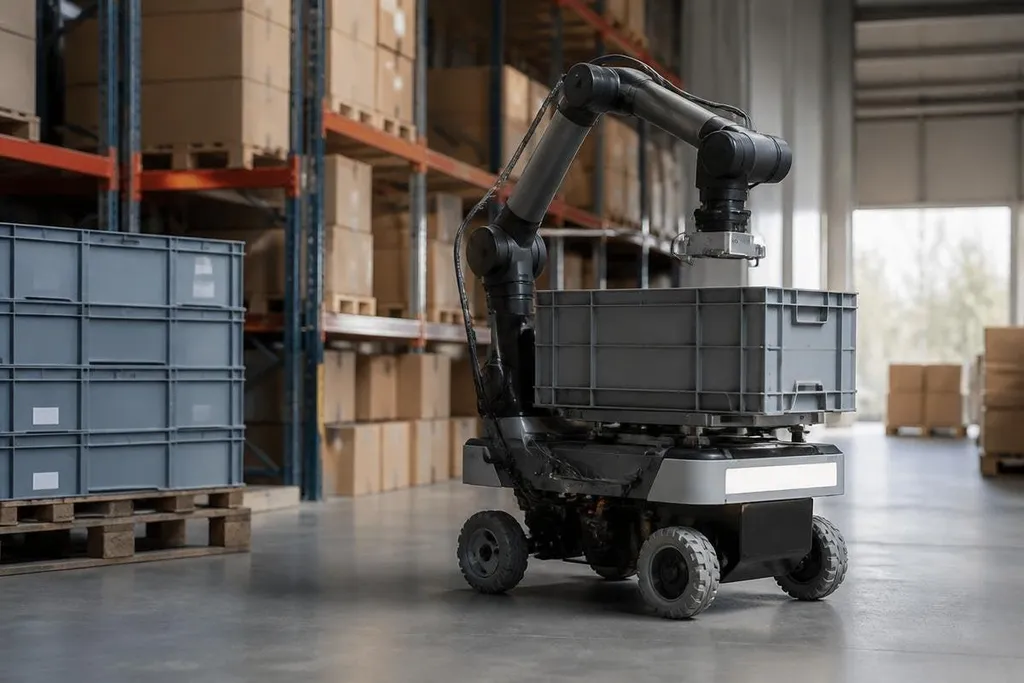
A robot that uses 240 W for ten minutes spends about 40 Wh on one task. That number tells you more than a battery size or a motor label. For factories, farms, and warehouses, lower energy use can cut running costs without slowing the work.
- Measure the task: watts per pick, metre, inspection, or delivery
- Check the full system: motors, sensors, computers, cooling, and charging losses
- Watch the duty cycle: idle time can matter as much as movement
Why battery size misses the point
A battery rated at 1 kWh stores 1,000 Wh before conversion losses. At a 500 W draw, the system could run for about two hours on paper. At 100 W, that time rises to about ten hours. Real run time depends on load, speed, stops, terrain, and the battery’s usable range.
That makes battery capacity a poor stand-in for energy efficiency. The useful measure is energy per completed job. For a mobile robot, the figure should be Wh per metre or Wh per delivery. An arm should report Wh per cycle at a stated payload, speed, and reach.
The test conditions matter. With a 2 kg load, a slow short cycle will use less energy than the same load moved quickly across a full reach, so the number needs its task beside it.
Where robots can cut energy use
Motion takes the largest share in many robots, but the motor is only one part of the load.
Cameras, LiDAR, onboard computers, network equipment, brakes, and cooling systems draw power while the robot waits or moves. Control software can reduce waste by planning shorter paths and avoiding sharp starts. Lower speed can help too, though a slower robot may need more time to finish the same job. The right test compares energy per completed task, not power draw during one short movement.
Regenerative braking can send some motion energy back to the battery when a robot slows down. The amount depends on the motor, drive electronics, battery state, and movement pattern. A robot that stops every few metres may have more chances to recover energy than one that moves at a steady speed.
Design choices also matter. A lighter arm needs less force to move its own links. A wheel with lower rolling resistance needs less drive power on a smooth floor. Better insulation can reduce the power needed to keep a battery or control cabinet within its working temperature range.
The number buyers should ask for
Ask for a measured energy figure tied to a real task. “Low power” has little use without the load, speed, floor type, duty cycle, and time included.
Energy use depends on the task, so energy robotics reporting from Robot24.com can give you the machine, load, speed, and test setting behind a claim. That record matters before you compare battery use during work with power drawn while the robot waits.
A useful report should include standby power too. If a robot draws 80 W while waiting and works for 8 h per shift, standby use reaches 640 Wh before the first task starts. A machine that saves energy while moving can still waste power during long gaps.
Charging losses belong in the same calculation. If a robot takes 1.2 kWh from the wall to store 1 kWh in its battery, the extra 200 Wh belongs in the operating cost. Leaving that figure out makes the robot look better on paper than it is at the socket.
A buying checklist for energy use
Use these questions before comparing two robots:
- Name the job: Ask for Wh per completed cycle, delivery, inspection, or metre.
- Set the load: Check the payload, tool weight, reach, speed, and floor conditions used in the test.
- Count waiting time: Add standby power during breaks, queues, charging, and shift changes.
- Check the wall figure: Include charger and battery losses, not only the battery’s stored energy.
- Price the work: Multiply energy per task by the number of tasks per day and the local electricity rate.
This checklist also exposes weak comparisons. A robot with a smaller battery may still use more electricity if it needs frequent charging or takes twice as long to finish each job.
What comes next
Energy data will become easier to compare when makers publish the same task conditions. Until then, ask for watts, watt-hours, payload, cycle time, and charging losses in one table.
I'd choose a robot with a clear Wh-per-task figure over one with a larger battery and vague claims. The useful question is now simple: how many watt-hours does the machine spend to finish one real job?